

Ancient Road Publications |
 |
|
The Modern Dead Sea and Genesis Fourteen
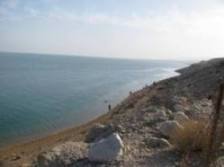
M odern environmental factors and recent geological research have helped us to solve a puzzle that has been posed by a text in Genesis chapter fourteen. The Bible tells us that in the time of Abraham four kings from the north attacked the kings of Sodom, Gomorrah and three nearby cities (14:1,2). The people were made vassals of the northern kings for twelve years, and in the thirteenth year the southern cities rebelled (14:4). This brought retaliation upon the southern cities the next year (14:5). The kings of the north carried off their possessions and took captive their people, including Lot, Abraham’s nephew (14:12). When Abraham learned of the disaster, he marshaled his servants to a number of 318 and pursued the attackers, rescuing the goods that had been taken, along with Lot and the other captives (13:16). Two elements of this account have proven to be a puzzle. First, the text tells us, “all these joined together in the Valley of Siddim (that is, the Salt Sea).” (14:3, NKJV). How could the “Salt Sea” (i.e. the Dead Sea) be their battlefield? How could their battlefield be a valley and sea? Second, the text says, “Now the Valley of Siddim was full of asphalt pits; and the kings of Sodom and Gomorrah fled; some fell there, and the remainder fled to the mountains.” (Genesis 14:10, NKJV). Where are these mysterious “asphalts pits”? Students of Biblical geography are familiar with Bible maps that show the large lake which dominates southern Palestine that was known in Old Testament times as the “Salt Sea” and more recently as the “Dead Sea.” Maps will generally show a large northern basin and a smaller southern basin separated by a peninsula that nearly separates the two. A few years ago I saw a satellite photograph of the modern lake and was shocked to see that it is dramatically different from the representations of the lake in Bible maps. Now the northern and southern basins are completely isolated from one another and the southern basin is dried up, except for controlled evaporation ponds used for the extraction of minerals. Geological study of the mountains that surround the southern basin suggests that this rise and fall of the water level of the southern basin has occurred at various times in history. Amos Frumkin and Yoel Elitzur in a recent article in Biblical Archaeology Review entitled “The Rise and Fall of the Dead Sea,” claim that geologists have discovered evidence at Mount Sedom, which rests on the southwestern shore, that correlates with the Biblical account. The evidence suggests that around 3000 B.C. the lake level was at one of its highest stages, and then dropped dramatically from 2500-2000 B.C. Around 2100-1800 B.C. the southern basin was dried up and the “valley” was exposed. By 1500-1200 B.C. the levels rose again, connecting the northern and southern basins making the valley again a part of the “Salt Sea” (pp. 46-48). While geology and
ancient dating are not perfect sciences and often arrive at questionable
conclusions this data is interesting. The book of Genesis was revealed to Moses
during the time of the Exodus somewhere between 1440-1400 B.C. (Coffman, p.
18-19). Moses, in describing the location of the ancient battle refers to the
geological conditions of his day placing the battle where the Salt Sea had
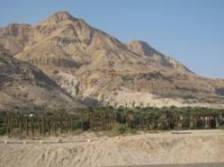
risen by then. En Gedi
But what about the “asphalt pits?” Frumkin and Elitzur observe that modern conditions in the southern basin in many ways present these very features. The geology of the area causes the ground around and within the dried up basin to be brittle and filled with pits that are formed when the ground breaks through to an underground opening. Pools of evaporating salt water and bacteria form naturally as the water recedes over time. They cite an incident in 1998 when a young woman at a campsite at En Gedi fell into a 25 foot deep pit when the ground gave way underneath her. Our salvation does not depend upon unraveling every puzzle that we may find in Scripture. Yet, when we are reminded that the events which the Bible describes are records of real people that served God in the past our faith can be strengthened and the critics silenced. Works Cited Clarke, Adam. Commentary and Critical notes of the Holy Bible. Vol. 1. New York: Abingdon-Cokesbury Press. Coffman, James Burton. Commentary on Genesis. Abilene: ACU Press, 1985. Frumkin, Amos and Yoel Elitzur. “The Rise and Fall of the Dead Sea.” Biblical Archaeology Review 27:6 (2001): 42-50.
|
|
Pope, Kyle. "The Modern Dead Sea and Genesis Fourteen" Biblical Insights 2.2 (February 2002): 24. |

|
Home Studies Outlines Photos Graphics Fonts Books Tracts Hymns Contact Us |
